
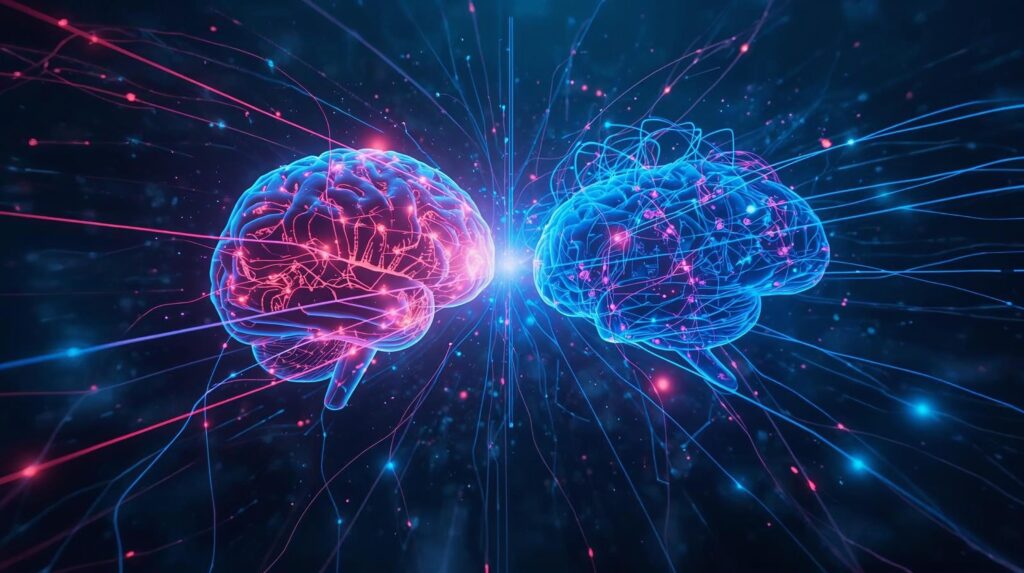
Artificial Intelligence today feels almost magical. Machines can recognize faces, understand speech, translate languages, diagnose diseases, and even create realistic images or stories. Behind most of these abilities is one powerful idea – neural networks. They are the core technology driving modern AI systems, especially deep learning models like ChatGPT, self-driving cars, and image recognition tools. But why are they called “neural” networks? And how closely do they actually resemble the human brain? To understand this, we need to explore both the biology of the brain and the structure of artificial neural networks in a simple, clear way.
Neural networks do not truly “think” like humans, but they borrow design inspiration from the way real neurons communicate. This inspiration is the foundation that makes modern AI possible. This article explains, step by step, how neural networks work, how they mimic the brain, and where the similarities end.
1. The Human Brain – Nature’s Original Neural Network
Before understanding artificial neural networks, it helps to understand how the biological version works. The human brain is one of the most complex systems in the universe. It contains about 86 billion neurons, each connected to thousands of other neurons. These neurons communicate through electrical signals and chemical interactions.
What real neurons do
Each neuron has three main parts,
- Dendrites – receive signals from other neurons
- Cell body (soma) – processes the signal
- Axon – sends the signal to the next neuron
When a neuron receives enough input, it “fires” an electrical signal that travels down the axon and communicates with other neurons. Over time, these connections strengthen or weaken based on experience. This ability to change is called neuroplasticity, and it is what allows humans to learn.
How the brain learns
The brain does not store instructions; it stores patterns. For example –
- You learn to recognize your friend’s face by seeing many variations of it over time.
- You learn a language by hearing repeated examples.
- You learn a skill by practicing it repeatedly.
The brain becomes better at a task by reinforcing the pathways used most frequently. Artificial neural networks use a similar idea: they adjust the strengths of their connections during training.
2. What Is an Artificial Neural Network (ANN)?
An artificial neural network is a system of mathematical functions arranged in layers. Like the brain, it tries to learn patterns from data, not through explicit rules.
Basic structure of an ANN
A neural network has three major parts,
- Input layer – receives data
- Hidden layers – process the data through many interconnected nodes
- Output layer – produces the final prediction
Each node (also called a neuron) performs a simple calculation – it takes input, multiplies it by weights, adds a bias value, and passes the result through an activation function.
In simple terms,
Input → Processing → Output
This mirrors how biological neurons receive signals, process them, and send signals forward.
3. How Neural Networks Mimic the Brain
Although artificial neural networks are not biological, they borrow several key ideas from neuroscience. These similarities explain why they can solve complex problems like image recognition or language translation.
a) Neurons and Nodes
Artificial nodes act like simplified neurons,
- They receive inputs
- They combine the inputs
- They decide whether to activate
- They pass signals to other nodes
This “signal passing” resembles brain activity, although in a much simpler, mathematical form.
b) Connections and Weights
Just like neurons in the brain have stronger or weaker connections, artificial neural networks use weights to control how strongly one node influences another.
- High weight → strong influence
- Low weight → weak influence
During training, the network adjusts these weights to learn patterns. This mirrors neuroplasticity in the brain, where practice strengthens neural pathways.
c) Learning by Examples
Just as humans learn from repeated experience, neural networks learn from repeated exposure to data.
For example,
- A child learns what a cat looks like by seeing many cats.
- A neural network learns to identify cats by analyzing thousands of images and spotting patterns (ears, whiskers, fur texture, etc.).
The machine doesn’t memorize the images; it learns the underlying features.
d) Layers and Hierarchies
Human perception works in layers,
- The eyes detect edges
- The brain combines edges into shapes
- Shapes form objects
- Objects form scenes
Neural networks operate in the same hierarchical style,
- First layers detect simple patterns (lines, colors)
- Middle layers detect shapes (eyes, wheels)
- Later layers detect full objects (faces, cars)
This layered understanding is a key reason deep learning is so powerful.
4. How Neural Networks Actually Learn – The Training Process
A neural network improves through a process called training, which involves adjusting weights to reduce errors.
Here’s how it works in a simple, beginner-friendly way,
Step 1 – Make a guess
The network takes input and produces an output,usually an incorrect one at first.
Step 2 – Compare the guess to the correct answer
The system calculates how wrong its guess was. This difference is called loss.
Step 3 – Adjust the connections
Using an algorithm called backpropagation, the network adjusts its weights to reduce future mistakes.
Step 4 – Repeat millions of times
Over many cycles, the network improves and eventually becomes accurate.
Why this resembles human learning –
- When you make a mistake, your brain adjusts and you try again.
- When neural networks make a mistake, they adjust weights and retry.
This repeated improvement makes both humans and machines better over time.
5. Where Neural Networks Are Similar to the Brain
Although artificial networks are far simpler, the similarities are meaningful.
Similarities include,
- both learn from examples
- both strengthen connections over time
- both detect complex patterns
- both use layered processing
- both generalize from experience
- both work better with more data
- both can forget or misclassify things
- both operate using distributed processing
These parallels are what allow neural networks to handle tasks once thought uniquely human, such as recognizing speech or generating text.
6. Where Neural Networks and the Brain Are Very Different
Despite the inspiration, modern AI is not a digital brain. There are major differences.
Key differences –
- Complexity –
The human brain has billions of neurons, ANNs have thousands to millions of nodes. - Learning style –
The brain learns continuously, ANNs require huge datasets and repeated passes. - Energy usage –
The brain uses about 20 watts of power, large neural networks need thousands of watts. - Flexibility –
Humans can learn from one example, machines need many examples. - Understanding vs. pattern matching –
The brain understands meaning, neural networks recognize statistical patterns. - Consciousness and emotions –
The brain has awareness, feelings, and intentions, AI has none of these.
Neural networks are inspired by the brain, not copies of it.
7. Why Neural Networks Became So Powerful Today
The recent success of AI comes from a combination of three things,
1. More Data
The internet provides billions of examples for training.
2. Better Hardware
Graphics processing units (GPUs) make it possible to train large networks quickly.
3. New Algorithms
Innovations like convolutional networks and transformers dramatically improved learning.
Together, these advancements allowed AI to go from basic image recognition to generating human-like text or photorealistic images.
8. Real-World Examples of Neural Networks in Action
Neural networks today power many technologies, including,
- facial recognition
- voice assistants like Siri and Alexa
- medical image analysis
- translation apps
- self-driving cars
- recommendation systems on Netflix and YouTube
- ChatGPT and generative text models
- art and image generation tools
- fraud detection
Each of these works by identifying patterns in data and making predictions, just like the brain identifies patterns in experiences.
Conclusion
Neural networks represent one of the most powerful ideas in modern technology. They are inspired by the human brain’s structure, but they do not replicate its full complexity. Instead, they borrow key principles , like interconnected neurons, weighted communication, and learning through experience , to solve difficult problems. While the brain remains far more flexible and efficient, artificial neural networks have grown incredibly capable, enabling AI systems to understand language, recognize objects, diagnose diseases, and generate creative content.
As AI continues to advance, the connection between neuroscience and artificial intelligence will become even more important. Understanding how neural networks mimic the brain gives us insight not only into technology, but into ourselves.