
Introduction
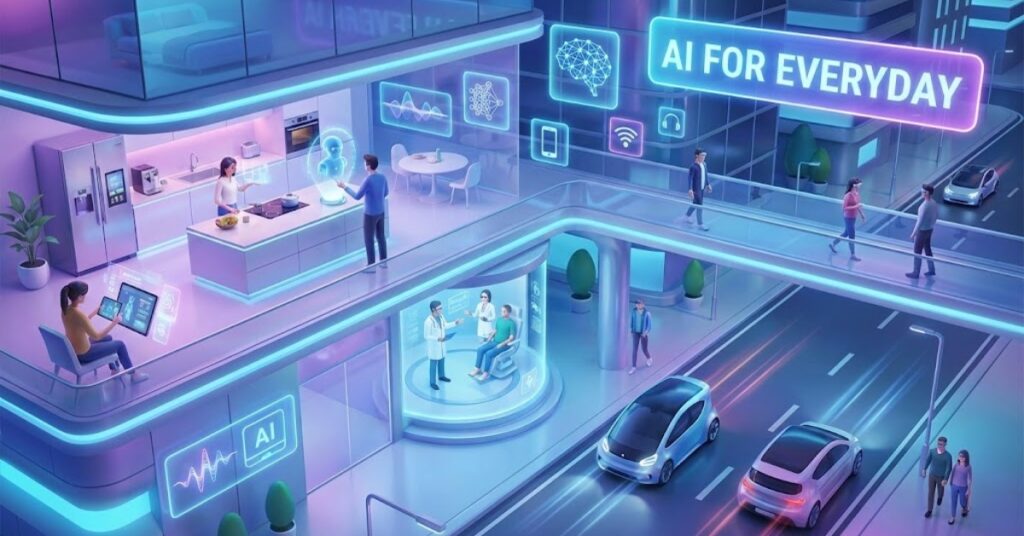
Artificial Intelligence (AI) is no longer a futuristic concept,it’s already a part of our daily routines. From the moment we wake up to the moment we go to sleep, AI influences the way we communicate, travel, shop, and even manage our health.
But what does it mean when we say “AI is changing everyday life”? How is this technology integrated into the apps, devices, and services we use daily?
This guide will explore practical examples of AI in action, explain how it works in everyday applications, and help you understand why it matters for everyone, even beginners.
1. AI in Communication and Social Media
Smart Assistants
AI powers voice assistants like Siri, Google Assistant, and Alexa. These assistants can:
- Answer questions instantly
- Set reminders or alarms
- Control smart home devices
- Send messages or make calls
Mini-Activity – Try asking your voice assistant a question you don’t know the answer to. Notice how quickly it finds the information.
Social Media Feeds
AI also decides what you see on platforms like Facebook, Instagram, and TikTok. Machine learning algorithms analyze:
- Your likes and shares
- Time spent on videos
- Interactions with friends or accounts
This analysis determines which posts or videos are shown at the top of your feed, creating a personalized experience.
Mini-Activity – Scroll through your social media feed and guess why certain posts appear first. Many are powered by AI learning your preferences.
2. AI in Online Shopping and Recommendations
Personalized Shopping
E-commerce platforms like Amazon use AI to recommend products based on your browsing history, past purchases, and search queries.
Smart Recommendations
Streaming services like Netflix or Spotify rely on AI algorithms to suggest movies, shows, or music tailored to your tastes.
Mini-Activity – Think of the last time a recommendation surprised you by being exactly what you wanted. That is AI learning from your habits.
Fraud Detection
Online payment systems use AI to detect unusual patterns in transactions and prevent fraud. For example:
- Buying large items from a new location triggers alerts
- Multiple failed login attempts are flagged
AI helps keep your financial information secure automatically.
3. AI in Daily Productivity
Email and Messaging
AI powers features like –
- Spam filtering in Gmail
- Smart replies in messaging apps
- Grammar and style suggestions in writing tools
These tools save time, reduce mistakes, and make communication more efficient.
Smart Calendars
Applications like Google Calendar use AI to:
- Suggest meeting times based on availability
- Predict the best time for reminders
- Automatically adjust schedules
Mini-Activity – Check how often AI-suggested scheduling helps you save time. Notice the convenience it adds.
4. AI in Transportation
Navigation Apps
Apps like Google Maps and Waze use AI to –
- Predict traffic congestion
- Suggest alternative routes
- Estimate arrival times
Autonomous Vehicles
Self-driving cars rely on deep learning and computer vision to detect –
- Pedestrians and other vehicles
- Traffic signals and signs
- Road obstacles
While fully autonomous cars are still in development, AI already helps make driving safer and more efficient.
Mini-Activity – Observe how your GPS app changes routes based on real-time traffic. That is AI predicting optimal paths.
5. AI in Healthcare
Medical Imaging
AI helps doctors analyze X-rays, MRIs, and CT scans to detect anomalies faster and more accurately.
Virtual Health Assistants
AI chatbots provide –
- Symptom checking
- Medication reminders
- Health advice based on guidelines
Predictive Healthcare
Machine learning algorithms analyze large datasets to predict disease outbreaks or identify high-risk patients.
Mini-Activity – Consider a wearable device you might use (like a Fitbit or Apple Watch). How does it use AI to track activity, sleep, or heart rate trends?
6. AI in Home and Lifestyle
Smart Homes
AI automates home systems for comfort and efficiency –
- Smart thermostats adjust temperature automatically
- Voice-controlled lighting and appliances
- Security cameras with facial recognition
Entertainment
AI also powers content creation tools –
- Photo and video editing apps
- Music or art recommendation platforms
- Video game AI opponents that adapt to your skill level
Mini-Activity – Check your home devices to see which of them are using AI to improve your experience.
7. AI in Education and Learning
Personalized Learning
AI can adapt lessons and quizzes based on a student’s performance. Platforms like Duolingo or Khan Academy tailor content to individual learning speeds.
Virtual Tutors
AI-powered chatbots can answer questions, provide explanations, or guide students through exercises, supplementing teacher instruction.
Mini-Activity – If you use an online learning platform, notice how it suggests lessons or practice problems. That is AI helping optimize your learning.
8. The Future of AI in Daily Life
AI continues to expand into areas such as –
- Smart cities – traffic optimization, energy efficiency
- Environmental monitoring – predicting natural disasters
- Workplace automation – smarter tools and workflows
Understanding AI’s role in everyday life prepares you to use these technologies responsibly and effectively.
Conclusion
AI is no longer a concept of science fiction,it’s a reality that affects nearly every aspect of our lives. From communication, shopping, and transportation to healthcare, home automation, and education, AI enhances efficiency, personalization, and safety.
By observing how AI interacts with daily tasks, we can appreciate its benefits while remaining aware of ethical considerations, such as privacy and data security.
The more we understand AI in everyday life, the better we can leverage its potential to make work, learning, and personal activities smarter, safer, and more enjoyable.