
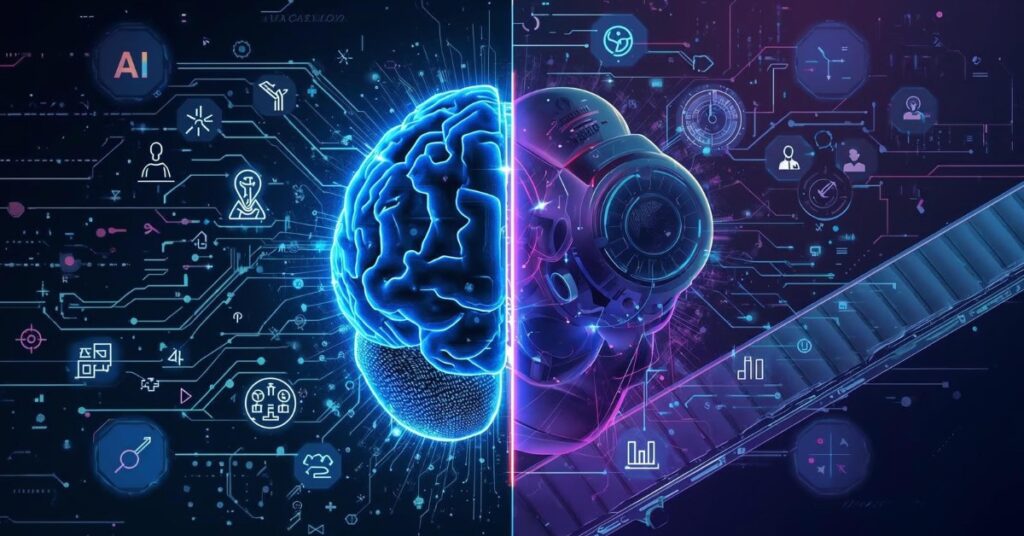
Artificial Intelligence (AI) and Automation are two of the most commonly used words in today’s technology discussions. But despite how often they appear together, many people still confuse them or use them interchangeably. In reality, AI and Automation are very different in purpose, behavior, capability, and complexity. Understanding the difference is not only important for students or tech beginners.it is essential for anyone working in business, engineering, management, or digital transformation.
This article explains the real difference between AI and Automation in simple, beginner-friendly language, using examples, comparisons, and practical explanations. By the end, you will clearly understand what each technology does, where they overlap, and how they shape our everyday lives.
1. What Is Automation?
Automation is technology that follows fixed rules to complete tasks with little or no human involvement. It works best when tasks are predictable, repeated, and do not require thinking or decision-making.
In simple words,
Automation is when a machine or system does the same task over and over, following instructions created by humans.
It does not “learn.”
It does not “think.”
It does not “adapt unless humans change the rules.”
Real-life examples of automation –
- A washing machine running a preset program
- An ATM dispensing cash
- A factory robot arm lifting and placing items
- Email auto-responses (“Thank you for your message…”)
- Payroll systems calculating monthly salaries
Automation is extremely reliable because it performs the same task perfectly every time as long as the conditions remain the same.
Key features of automation –
- Rule-based
- Predictable and repetitive
- High accuracy, low flexibility
- Works exactly as programmed
- Cannot improve on its own
Automation saves time, reduces workload, and eliminates human error in repetitive tasks.
2. What Is Artificial Intelligence?
Artificial Intelligence (AI) refers to computer systems that can learn, reason, and make decisions, similar to how humans think. Unlike automation, AI is not limited to fixed rules. It improves through data, adapts to new situations, and solves problems on its own.
In simple words,
AI is a system that learns from data and makes decisions or predictions without needing constant human instructions.
AI does not just follow rules,it creates new strategies based on patterns it discovers.
Real-life examples of AI,
- ChatGPT writing text or answering questions
- Google Maps predicting traffic
- Netflix recommending movies
- Face recognition on smartphones
- Fraud detection in banking
- Self-driving car decision-making
AI systems continue improving the more they are used.
Key features of AI –
- Learns from data
- Adapts to new information
- Handles unclear or complex tasks
- Predicts outcomes
- Makes independent decisions
More flexible and powerful than automation
Artificial Intelligence is designed for tasks where the answer is not fixed,and where the system needs to understand patterns.
3. The Core Difference Between AI and Automation
Although AI and Automation often work together, they are very different technologies. An easy way to understand the difference is to compare mindless repetition with smart decision-making.
Automation = Doing tasks
AI = Understanding and improving tasks
A simple comparison,
| Feature | Automation | AI |
| Learns from data | No | Yes |
| Adapts to new situations | No | Yes |
| Follows fixed rules | Yes | Not always |
| Handles repetitive tasks | Excellent | Possible but unnecessary |
| Handles complex decisions | Weak | Strong |
| Requires human programming | High | Medium |
| Flexibility | Low | High |
| Goal | Efficiency | Intelligence & Decision making |
Automation is a machine doing exactly what it’s told.
AI is a machine figuring out what to do.
4. Real-World Example Breakdown – AI vs Automation
To make the difference clearer, here are real scenarios where you can see how each technology behaves.
Example 1 – Emails
- Automation – Sends automatic “Thank you for your message” replies.
- AI – Reads the email, understands the meaning, drafts a personalized reply.
Example 2 – Manufacturing
- Automation – A robot arm repeatedly moves boxes from point A to B.
- AI – A robot that detects defective products using computer vision and learns to improve accuracy.
Example 3 – Customer Support
- Automation – Press 1 for English, Press 2 for Sinhala…
- AI – Chatbots that understand your sentences and respond intelligently.
Example 4 – Security
- Automation – Locks the door at 10 p.m. every day.
- AI – Identifies suspicious activity and alerts the owner automatically.
These examples show that automation follows rules, while AI interprets, reasons, and responds to new information.
5. Can Automation and AI Work Together? (Yes!)
Most modern systems combine both technologies. Automation handles the predictable parts, while AI handles the unpredictable parts.
A simple example – Smart home system
- Automation – Turns lights on at 6 p.m.
- AI – Adjusts brightness based on natural light and your habits.
Another example – Customer service
- Automation – Ticket creation
- AI – Understanding the complaint and suggesting solutions
Together, they create smarter, more efficient systems.
6. Benefits of Automation
Automation brings several advantages, especially in industries with repetitive tasks.
Main benefits,
- High accuracy
- Fast processing
- Reduced human errors
- Cost savings
- Consistency
- Increased productivity
Companies use automation to streamline operations and eliminate manual, rule-based tasks.
7. Benefits of AI
AI provides deeper value by thinking, learning, and making decisions.
Main benefits,
- Handles complex tasks
- Learns and improves over time
- More flexible than automation
- Generates predictions
- Personalizes user experience
- Helps in problem-solving and innovation
AI is essential in tasks that require intelligence, such as analysis, pattern detection, and decision-making.
8. Limitations of Each Technology
Limitations of Automation
- Cannot handle surprises
- Fails when conditions change
- Requires constant human updates
- Not useful for creative or analytical tasks
Limitations of AI
- Requires huge amounts of data
- Sometimes makes mistakes
- Harder to control and explain
- Training costs can be high
- Can be biased depending on the data
Both have strengths, and both have weaknesses.
9. When Should You Use AI vs Automation?
If the task is predictable, choose Automation.
If the task requires thinking, learning, or decision-making, choose AI.
Use Automation for,
- Repeating the same actions
- Scheduled tasks
- Data entry
- Manufacturing steps
- Workflow automation
Use AI for,
- Understanding language
- Making predictions
- Personalization
- Complex problem-solving
- Image or voice recognition
Many companies combine both, but knowing when to use which technology is essential for building efficient systems.
10. The Future of AI and Automation
The future involves more integration between both technologies.
What to expect,
- Smarter automated workflows
- Self-correcting production lines
- AI-driven customer service
- Automated business decision-making
- Robots that both automate and think
- AI assistance in daily tools (phones, apps, cars)
As AI becomes more powerful, automation becomes smarter. And as automation improves, AI systems become more useful in real environments.
Conclusion
AI and Automation are connected but not the same. Automation follows strict rules to complete routine tasks, while AI learns from data and makes decisions. Automation gives consistency and speed. AI brings intelligence and adaptability. When combined, they create powerful systems capable of transforming industries, businesses, and even everyday life.
Understanding the difference helps you appreciate how modern technology works.and how you can use it effectively in your studies, workplace, or digital projects.