
Introduction
You’ve probably heard these three terms everywhere:
- Artificial Intelligence (AI)
- Machine Learning (ML)
- Deep Learning (DL)
Many people assume they are the same, but each has its own meaning and scope. Understanding the differences is essential not only for tech enthusiasts but also for anyone navigating today’s increasingly AI-driven world.
The Simple Relationship
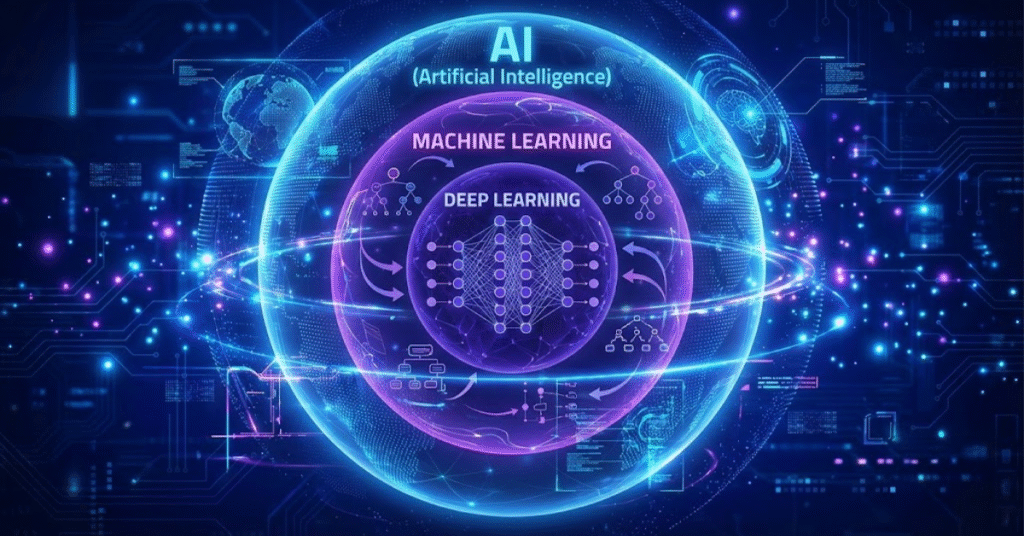
Here’s a clear way to visualize the hierarchy ,
Deep Learning ⟶ part of Machine Learning
Machine Learning ⟶ part of Artificial Intelligence
Artificial Intelligence ⟶ the broad field
Think of it like a set of Russian dolls,
- AI = the largest doll, the entire concept of machines behaving intelligently
- ML = a smaller doll inside, representing learning from data
- DL = the smallest doll inside, representing advanced learning using neural networks
1. What Is Artificial Intelligence (AI)?
Simple Definition
AI refers to machines or software designed to simulate human intelligence.
It is the broad umbrella that covers,
- Reasoning – Making decisions based on available data
- Problem-Solving – Tackling complex challenges like a human would
- Language Understanding – Understanding and responding to human language
- Perception – Recognizing images, sounds, and patterns
Practical Examples
- Voice assistants – Siri, Google Assistant, Alexa
- Navigation apps – Google Maps predicting traffic patterns
- Chatbots – Customer service helpers that respond instantly
- Video games – Opponents that adapt to player strategies
Mini-Activity
Think about your day today – Can you identify three tasks that used AI without you realizing it? For example, did your email filter spam or did a recommendation engine suggest content you liked?
2. What Is Machine Learning (ML)?
Simple Definition
Machine Learning is a subset of AI where computers learn from data rather than being explicitly programmed for every task.
ML systems improve automatically when exposed to more data and examples. For instance, instead of programming rules to detect spam, you feed the system many examples of spam and non-spam emails, and it figures out the patterns.
Practical Examples
- Gmail automatically filtering spam
- Facebook recognizing your friends’ faces in photos
- Netflix or Spotify recommending movies and music
- Credit card companies detecting fraudulent transactions
Mini-Activity
Imagine teaching a friend the difference between cats and dogs. You show them 50 pictures of each, pointing out characteristics like ear shape, tail length, and fur patterns. After a while, your friend can identify cats and dogs on their own. That’s Machine Learning in action.
3. What Is Deep Learning (DL)?
Simple Definition
Deep Learning is a subset of Machine Learning that uses artificial neural networks with many layers. It can handle complex problems that require large amounts of data and computational power.
Practical Examples
- Self-driving cars that recognize traffic signals and pedestrians
- ChatGPT responding to natural language queries
- Google Photos automatically tagging faces in your pictures
- Advanced medical image analysis, such as detecting tumors
Mini-Activity
Consider your phone’s face unlock feature. It recognizes you even in low-light conditions or with glasses on. This is deep learning analyzing multiple layers of data to make accurate decisions.
Visual Understanding
| Term | Explanation |
| AI | Make machines smart by simulating human intelligence |
| ML | Make machines learn patterns from data |
| DL | Make machines learn a lot from big data using layered neural networks |
Everyday Life Examples
AI
A video game opponent that adjusts difficulty based on your skill level.
ML
Spotify recommending songs you might enjoy based on your listening habits.
DL
Google Photos recognizing faces in your images automatically, even if the environment or angle changes.
Additional Example
- AI powers your GPS app, ML predicts traffic patterns, and DL recognizes road signs and pedestrians in autonomous vehicle systems. By combining all three, technology becomes more intelligent and efficient.
Why People Get Confused
Many people mix up AI, ML, and DL because,
- Overlap exists – DL is part of ML, and ML is part of AI.
- Marketing buzzwords – Companies often label any smart system as AI.
- Technical jargon – Terms like neural networks, supervised learning, or predictive modeling are confusing without examples.
Mini-Activity
Write down three AI tools you used this week. Next to each, identify whether it relies on general AI, machine learning, or deep learning. This exercise clarifies the distinctions in practical scenarios.
Key Differences
| Feature | AI | Machine Learning | Deep Learning |
| Scope | Broad field of making machines intelligent | Subset of AI that learns from data | Subset of ML using neural networks |
| Data Requirement | Low–Medium | Medium | Very high |
| Human Involvement | High | Medium | Very low |
| Computing Power | Low | Medium | High |
| Tasks | Decision-making, reasoning | Pattern recognition | Complex tasks like image, speech, and language |
| Examples | Chatbots, smart assistants, game AI | Spam detection, recommendation systems | Self-driving cars, face recognition, voice assistants |
Conclusion
Now you can confidently explain the difference between these technologies:
- AI – The overall concept of making machines intelligent
- ML – Machines learning from data to improve performance
- DL – Advanced ML using neural networks to handle complex tasks
Understanding these distinctions not only helps you follow tech discussions and trends but also gives you insight into how the tools and apps you use daily actually work.
By recognizing how AI, ML, and DL operate in your life, you can better appreciate the technology shaping your present and future.
Pingback: How to Learn AI Without Coding The Ultimate Beginner's Guide