
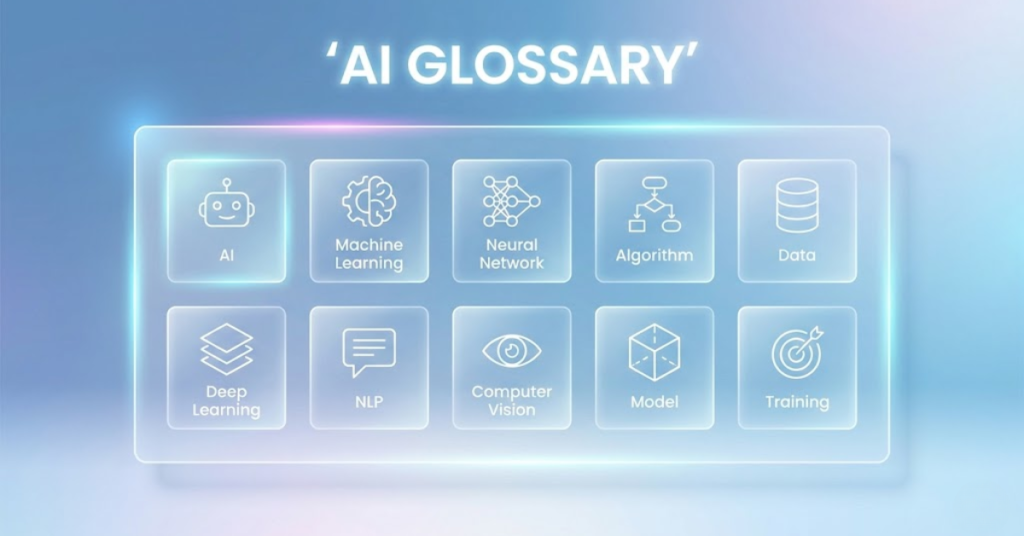
Artificial Intelligence (AI) often sounds complex because it uses many technical terms. But most concepts become easy to understand when they are explained in simple language with real-life examples.
This glossary breaks down 25 essential AI terms from A to Z, giving beginners a clear explanation of each term and how it connects to everyday technology. If you are starting to learn AI, this list will help build a strong foundation.
1. Artificial Intelligence (AI)
AI refers to machines or software that can perform tasks that normally require human thinking.
Examples include understanding language, playing games, making decisions, or recognizing images.
AI does not “think” like humans. It learns patterns from data and uses them to make predictions or decisions.
2. Algorithm
An algorithm is a set of rules or instructions that tells the computer how to solve a problem.
In AI, algorithms process data and help machines learn from it.
Example – A recipe is like an algorithm because it gives step-by-step instructions.
3. Artificial Neural Network (ANN)
A neural network is a computer system inspired by the human brain.
It contains layers of “neurons” that pass information to each other.
Neural networks are used in,
- image recognition
- speech recognition
- recommendation systems
4. Big Data
Big Data refers to extremely large amounts of information that are too big for traditional systems to handle.
AI uses Big Data to learn patterns, especially in industries like finance, healthcare, and social media.
5. Chatbot
A chatbot is an AI tool that can communicate with humans through text or voice.
Examples include customer support chatbots, website assistants, and virtual agents that answer questions 24/7.
6. Classification
A classification model sorts data into categories.
Examples –
- spam or not spam
- cat or dog
- positive or negative review
It is one of the most common tasks in machine learning.
7. Computer Vision
Computer vision allows machines to “see” and understand images or videos.
Examples –
- Face ID unlock
- Traffic cameras detecting cars
- Medical image analysis
It is heavily dependent on data from photos and videos.
8. Data Mining
Data mining is the process of discovering patterns, connections, or useful insights from large datasets.
Companies use it to understand customer behavior, detect fraud, and improve decision-making.
9. Dataset
A dataset is a collection of data used to train, validate, or test an AI model.
For example, a dataset for image recognition might contain thousands of labeled photos.
Good datasets equal better AI performance.
10. Deep Learning
Deep learning is a special type of machine learning that uses large neural networks with many layers.
It is used in,
- self-driving cars
- voice assistants
- advanced image recognition
Deep learning requires large amounts of data and powerful hardware.
11. Feature
A feature is an individual piece of information used by an AI model to make decisions.
Examples,
- Age or income in a loan prediction model
- Pixel colors in an image
- Words in a sentence
Features help AI understand patterns more clearly.
12. Generative AI
Generative AI creates new content such as text, images, music, or videos.
Examples –
- AI writing tools
- AI art generators
- AI-powered video or music creation
It learns from huge amounts of data and generates original outputs.
13. Label
A label is the correct answer associated with each example in a dataset.
For example –
- An image labeled “dog”
- A message labeled “spam”
- A sound clip labeled “female voice”
Labels are essential for supervised learning.
14. Machine Learning (ML)
Machine learning is a type of AI where computers learn from data instead of being programmed manually.
The machine improves over time by studying patterns.
Examples –
- Netflix recommendations
- Fraud detection
- Predicting house prices
15. Model
An AI model is the final system created after training.
It receives input and gives output based on what it learned.
Example –
A weather prediction model uses past data to predict rain or sunshine.
16. Natural Language Processing (NLP)
NLP helps machines understand and work with human language.
Examples –
- chatbots
- translation tools
- sentiment analysis
- voice assistants
NLP deals with text and speech.
17. Neural Network Layer
A layer is a group of neurons in a neural network.
There are usually three types –
- input layer
- hidden layers
- output layer
More layers generally mean the model can learn more complex patterns.
18. Overfitting
Overfitting happens when an AI model learns the training data too well, including mistakes or noise.
As a result, it performs badly on new data.
Example –
A student who memorizes a textbook but cannot answer questions in their own words.
19. Prediction
A prediction is the output the model gives after analyzing data.
Examples –
- Predicting tomorrow’s weather
- Guessing the next word in a sentence
- Predicting whether a tumor is benign or cancerous
Predictions improve as the model learns from more data.
20. Reinforcement Learning
Reinforcement learning trains AI through rewards and penalties.
The AI learns by trial and error.
Examples –
- AI playing games like chess
- robots learning to walk
- self-driving cars adjusting speed
The AI chooses actions and learns from the results.
21. Supervised Learning
Supervised learning uses labeled data, meaning each example has a correct answer.
The AI learns by comparing its predictions with the correct labels.
Examples –
- classifying emails
- detecting diseases
- predicting prices
Most beginner ML projects use supervised learning.
22. Token
A token is a small unit of text used in NLP.
Words, subwords, or even characters can be tokens.
For example, the sentence
“AI is useful”
may be split into tokens,
AI | is | useful
Large language models process millions or billions of tokens.
23. Training
Training is the process where an AI model learns from data.
During training, the model adjusts its internal settings to reduce mistakes.
Longer training with good data usually creates better models.
24. Unsupervised Learning
Unsupervised learning uses unlabeled data.
The AI tries to find patterns or groups on its own.
Examples,
- grouping customers with similar interests
- organizing large sets of images
- understanding topics in text documents
Unsupervised learning is used when labeling data is too expensive or difficult.
25. Weights
Weights are values inside a neural network that determine how strongly inputs influence the output.
During training, the model adjusts its weights to learn patterns.
Better weights = better performance.
Conclusion
This glossary covers the 25 most important AI terms that every beginner should know. By understanding these key concepts, you can read AI articles with confidence, follow discussions more easily, and build a strong foundation for learning machine learning, deep learning, and data science.
AI may seem complicated at first, but once you understand the language, the concepts become much clearer. Use this glossary as a starting point for your journey into artificial intelligence.