
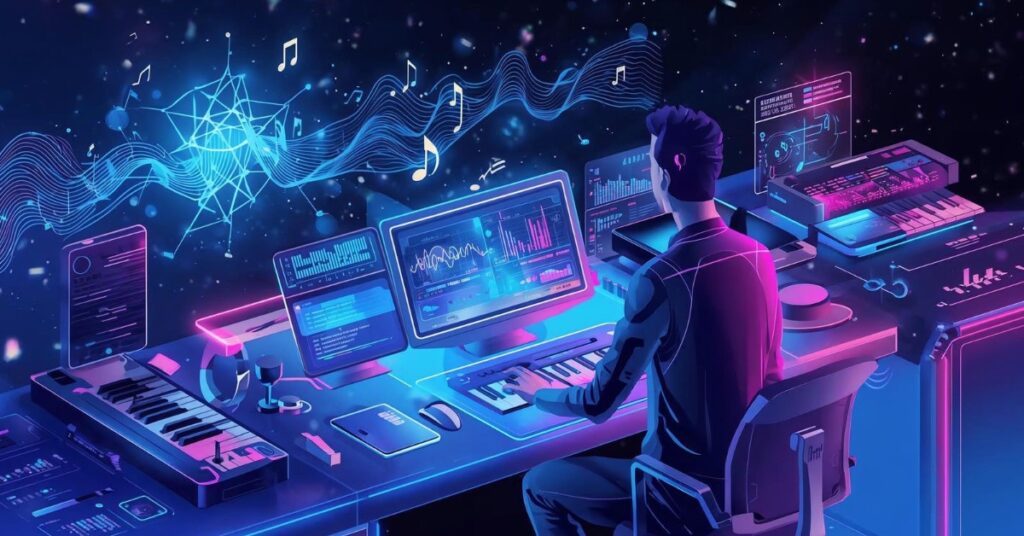
Music has always been an evolving art form, shaped by technology and creativity. From the invention of the piano to synthesizers, drum machines, and digital audio workstations, each innovation has expanded the boundaries of what is possible. Today, Artificial Intelligence (AI) is the latest tool redefining how music is created, performed, and experienced. AI is not replacing musicians; it is opening new creative avenues, allowing them to explore sounds, styles, and compositions that were previously impossible or too time-consuming to produce.
This article explores how musicians are using AI to make new sounds, the tools available, and how AI is shaping the future of music creation and performance.
AI as a Creative Partner for Musicians
One of the most exciting aspects of AI in music is its role as a creative partner. Musicians often use AI not to replace human creativity but to enhance it. AI can,
- Generate melodies, chord progressions, and rhythms
- Suggest harmonies and arrangements
- Provide real-time improvisation
- Help experiment with new genres or fusion styles
By offloading technical or repetitive elements, musicians can focus on emotional expression, composition, and storytelling through sound.
For example, a composer may input a few chord sequences into an AI tool, and the AI can generate multiple variations of melodies and harmonies. The musician can then select the ones that resonate most, tweak them, and integrate them into a larger piece.
AI-Generated Sounds and Instruments
AI is also transforming the types of sounds available to musicians. Traditional instruments have fixed timbres, but AI can create entirely new sounds that do not exist in nature or in standard synthesizers.
Examples –
- Custom virtual instruments – AI can generate unique timbres, combining the tonal qualities of multiple instruments.
- Voice synthesis – AI can produce vocal sounds, harmonies, and even realistic singing without a human singer.
- Experimental textures – From abstract electronic soundscapes to rhythmic noise patterns, AI expands sonic possibilities.
Musicians can now experiment with sounds that previously required extensive studio equipment or months of sound design work.
Popular AI Tools Musicians Are Using
Several AI platforms have become popular among musicians for generating new sounds and compositions,
1. Amper Music
- Cloud-based AI music composition tool
- Allows users to create background tracks by selecting mood, tempo, and style
- AI generates royalty-free music that can be customized
- Useful for video producers, indie musicians, and game developers
2. AIVA (Artificial Intelligence Virtual Artist)
- Specializes in composing symphonic music
- Can generate orchestral, cinematic, and classical music
- Musicians can edit and arrange compositions to match their vision
- Used in film scoring, games, and creative projects
3. Soundraw.io
- Focuses on AI-assisted music creation for content creators
- Offers options to adjust length, tempo, and genre
- Generates multiple variations for experimentation
- Particularly useful for social media and video content
4. LANDR
- Known for AI mastering, but also offers AI-generated music tools
- Helps musicians refine recordings with professional mastering quality
- Provides AI-driven loops and samples for creative inspiration
5. Jukedeck (now part of TikTok/ByteDance)
- AI-generated music for video and digital content
- Creates customizable tracks based on mood, length, and style
- Allows musicians to experiment with different musical directions quickly
AI in Songwriting and Composition
AI is not limited to sounds, it also plays a role in songwriting and arrangement –
- AI can suggest chord progressions, harmonies, and counterpoints
- Helps break writer’s block by generating multiple options
- Supports collaborative songwriting between human and AI
For example, a songwriter could provide a theme or emotional tone, and AI tools like OpenAI’s MuseNet or Google’s Magenta can generate musical phrases that align with that theme. The human musician then curates, edits, and arranges the pieces to form a complete composition.
AI for Music Performance and Live Shows
Beyond studio work, AI is also impacting live performances
- Interactive AI instruments – Instruments that respond dynamically to a performer’s input, creating evolving sounds
- Generative accompaniment – AI can play alongside musicians, improvising in real-time
- Visual-music integration – AI can synchronize lighting, visuals, and music for immersive experiences
Bands and solo performers are experimenting with AI to create performances that feel interactive and alive, expanding what a “live show” can mean.
Benefits of Using AI in Music
Using AI in music offers several advantages,
- Faster experimentation – Generate multiple musical ideas instantly
- Access to new sounds – AI can create instruments and tones not possible manually
- Enhanced creativity – Helps break creative blocks and explore unfamiliar styles
- Scalability – Musicians can produce high-quality tracks faster, suitable for media or commercial projects
Musicians can now spend less time on repetitive tasks and more time on the emotional and narrative aspects of music creation.
Challenges and Considerations
While AI is powerful, it is not without challenges,
- Quality variation – AI outputs may lack emotional depth or human nuance
- Over-reliance risk – Musicians may risk creativity becoming formulaic if relying too heavily on AI
- Ethical concerns – Copyright issues, ownership of AI-generated music, and transparency with audiences
- Technical learning curve – Understanding how to fine-tune AI tools can take time
The best results often come when AI is used as a collaborator, not a replacement for human creativity.
Future Trends in AI Music Creation
Looking ahead, AI is likely to shape music in several exciting ways,
- Hyper-personalized music – AI will generate tracks tailored to individual listener preferences
- Collaborative AI platforms – Musicians around the world can co-create in real-time using AI tools
- AI-enhanced instruments – Instruments with AI built in for adaptive sound generation
- Integration with VR/AR – Immersive environments where music and visuals evolve dynamically based on audience interaction
The boundary between human creativity and AI capability will continue to blur, opening limitless possibilities for innovation.
Tips for Musicians Using AI
To make the most of AI in music creation,
- Define your creative goal – Know what role AI will play in your workflow.
- Experiment freely – Generate multiple ideas without worrying about perfection.
- Combine human intuition – Select, refine, and add emotional depth to AI outputs.
- Respect ethical standards – Understand copyright and licensing for AI-generated music.
- Integrate into workflow – Use AI for ideation, sound design, or editing, not just final output.
By following these tips, musicians can leverage AI while preserving their unique artistic voice.
Conclusion
AI is transforming music creation, offering tools that extend human creativity into new realms. From generating novel sounds to aiding in composition, AI helps musicians experiment faster, produce higher-quality tracks, and explore styles that would have been challenging or impossible in the past. While AI can handle technical and repetitive tasks, the human element remains irreplaceable: emotion, taste, intuition, and cultural context.
Musicians who embrace AI thoughtfully will discover new ways to innovate, collaborate, and connect with their audience. The future of music is a partnership between human imagination and AI efficiency, and it promises to be more creative, diverse, and expressive than ever before.
I use AI and other tools to produce my music. I am always open to partnering with others that share the embracing grip of technology. You can check out my music at: markrbolducmusic.com