
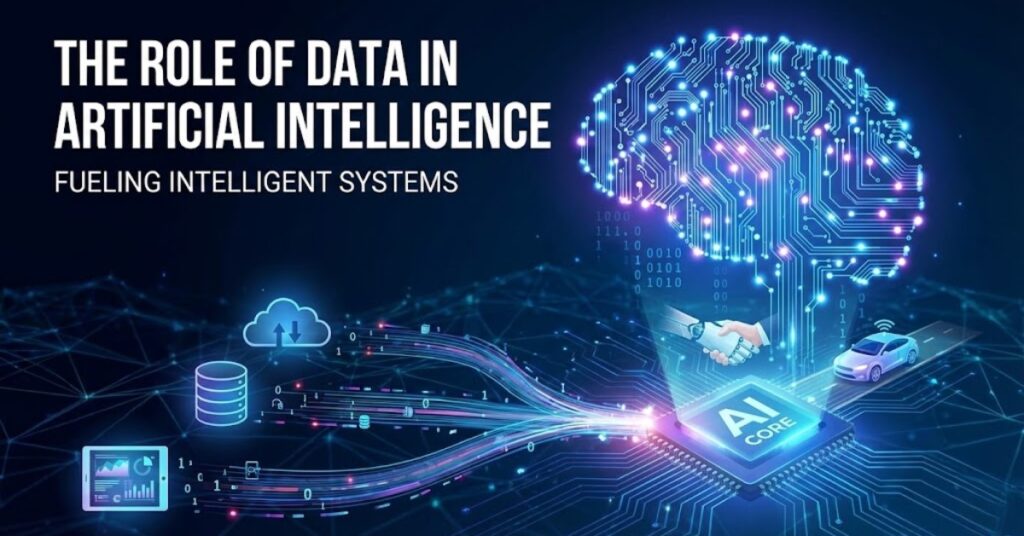
Artificial Intelligence (AI) may sound complex, but at its heart, it depends on one simple element – data. Data is the information AI learns from, just like humans learn from experience. Without data, AI cannot think, improve, make decisions, or perform any meaningful task.
Whether an AI is recommending movies, translating languages, driving cars, or detecting diseases, data is the foundation that makes these capabilities possible.
This beginner-friendly article breaks down exactly why data is so important for AI, how AI uses it, the types of data involved, challenges, and what the future of data-driven AI looks like.
1. Why Data Is the Foundation of AI
To understand the role of data, imagine teaching a child to recognize animals.
You show the child many pictures of cats and dogs. With enough examples, the child learns patterns,
Cats often have pointy ears.
Dogs often have different shapes and sizes.
AI works in the exact same way. The “examples” it learns from are data.
AI cannot learn without data
- A spam filter must see many spam and non-spam emails.
- A voice assistant must learn from thousands of recorded voices.
- A self-driving car must learn from countless hours of video footage.
If an AI receives only a small amount of data, or low-quality data, it will not learn correctly.
This is why data is more important than the algorithms themselves. Algorithms are like the brain, but data is the experience.
2. How AI Learns From Data
AI does not understand data immediately. It goes through different stages to learn properly. These stages help AI grow from a “beginner” to an “expert.”
Stage 1 – Training
This is where AI learns patterns.
The AI is shown thousands or millions of examples.
It then tries to understand the relationships in the data.
Example –
To learn to detect fraud, AI studies many past financial transactions. It learns what looks normal and what looks suspicious.
Stage 2 – Validation
In this stage, AI is tested during training to check if it is learning properly.
If the AI starts memorizing data instead of understanding it, validation helps adjust its learning.
Example –
If AI is identifying faces, validation checks whether it can recognize new faces, not just the training ones.
Stage 3 – Testing
This is the final exam.
AI is tested using completely new data it has never seen before.
Example –
If an AI is trained on hospital data from one city, testing checks whether it can diagnose patients in another city.
This entire cycle depends on data. The more accurate, clean, and diverse the data, the better the AI performs.
3. Types of Data AI Uses
AI can use many types of data, but beginners often get confused. Here are the types, explained simply.
1. Structured Data
This is clean, organized data often stored in tables.
Examples –
- attendance sheets
- bank statements
- customer information
- sales records
You can read it easily because everything is arranged neatly.
2. Unstructured Data
This is messy and not in table format.
Examples –
- photos
- videos
- audio recordings
- emails
- social media posts
- PDFs or Word documents
Most of the data in the world is unstructured, and deep learning models are very good at learning from it.
3. Semi-Structured Data
Not fully organized, but not completely messy.
Examples –
- JSON files
- logs from apps
- HTML from webpages
4. Labeled Data
This data comes with tags or labels.
Examples –
- images tagged “cat” or “car”
- emails tagged “spam” or “not spam”
- audio labeled with speaker names
AI learns faster with labeled data, but creating labels is time-consuming and expensive.
5. Unlabeled Data
No labels at all. Most real-world data is unlabeled.
Example –
- a folder of 10,000 photos with no names
AI must figure out patterns itself.
6. Real-Time Data
Data that arrives every second.
Examples –
- stock market prices
- GPS data
- temperature from sensors
- traffic cameras
Real-time data helps AI make instant decisions.
4. Why Data Quality Matters More Than Quantity
Many beginners believe AI improves by adding more data.
Quantity is important, but quality matters even more.
Here is why,
Accurate Data = Accurate AI
If the data has mistakes, the AI will learn those mistakes.
Example –
If medical images are incorrectly labeled, AI may diagnose diseases wrongly.
Complete Data = Better Learning
Missing information makes patterns unclear.
Example –
If half the customer records have missing ages or incomes, AI cannot predict buying behavior accurately.
Consistent Data = Correct Patterns
If data is stored in different formats, AI struggles.
Example –
If one system stores dates as DD/MM/YY and another as MM/DD/YY, the AI becomes confused.
Diverse Data = Fair and Reliable AI
If an AI is trained mostly on one group of people, it may fail on others.
Example –
A face recognition AI trained mainly on light-skinned faces performs poorly on dark-skinned faces.
Good data allows AI to learn correctly and produce trustworthy results.
5. How Data Is Collected for AI
AI developers use many methods to gather the data they need. Some are simple, others are technical.
1. Manual Data Collection
Humans gather and label data by hand.
Examples –
- labeling images
- medical specialists tagging X-rays
- writing descriptions for text datasets
2. Sensors and IoT Devices
Smart devices collect real-time information.
Examples –
- smartwatches collecting heart rate
- home cameras
- factory machines tracking performance
3. Web Scraping
AI collects information from websites to create datasets.
Example –
A language model collects text from articles, books, and forums.
4. Public Datasets
Researchers and companies release free, open datasets such as,
- ImageNet
- COCO dataset
- Kaggle datasets
- government open data portals
5. User-Generated Data
Every action on the internet creates data.
Examples –
- search queries
- likes and comments
- watch history
- online purchases
6. Synthetic Data
Artificially created data when real data is unavailable.
Examples –
- simulated driving environments
- computer-generated human faces
- artificial medical records that protect patient privacy
Synthetic data helps when real data is sensitive or limited.
6. Challenges of Data in AI
Even though data is powerful, it also brings challenges.
1. Privacy Issues
AI often uses personal data such as,
- names
- addresses
- health reports
- location
This must be protected to prevent misuse.
2. Data Bias
If the data is biased, AI decisions will also be biased.
Example –
If a loan approval AI is trained mostly on high-income applicants, it might wrongly reject low-income applicants.
3. Cost of Collecting Data
Building large, high-quality datasets requires time, money, and expertise.
4. Data Cleaning Takes Time
Raw data often contains,
- duplicates
- errors
- missing values
- wrong labels
Cleaning data can take up to 80% of the entire AI development time.
5. Security Risks
Large datasets attract cyberattacks, so security is essential.
7. Better Data = Better AI
AI improves dramatically with better data. High-quality data leads to,
- more accurate predictions
- fewer mistakes
- less bias
- more fairness
- better performance across different groups
- more reliable results
Improving data often produces better AI results than changing the algorithm itself.
8. The Future of Data in AI
The future of AI is focused less on creating new models and more on improving data. This shift is known as data-centric AI.
Future trends include,
- automated data cleaning
- smarter data labeling tools
- synthetic data that looks real
- self-supervised learning
- strict data protection rules
- real-time data ecosystems
These advancements will make AI more powerful, fair, and trustworthy.
Conclusion
Data is the most important ingredient of Artificial Intelligence. AI does not become smart on its own. It becomes smart by learning from examples, and those examples come from data. The quality, diversity, and accuracy of data determine how well AI performs, how fair it is, and how useful it becomes in the real world.
Understanding how data powers AI helps beginners appreciate why companies invest heavily in collecting, cleaning, and managing data. The future of AI will depend not just on advanced algorithms but on high-quality, ethically collected data that teaches machines to understand and interact with the world.